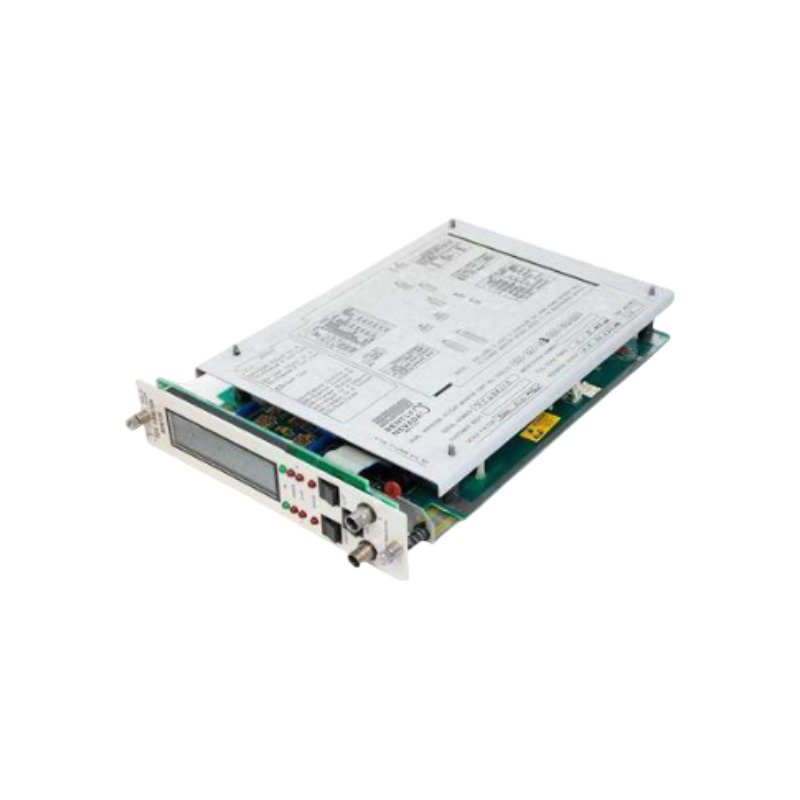
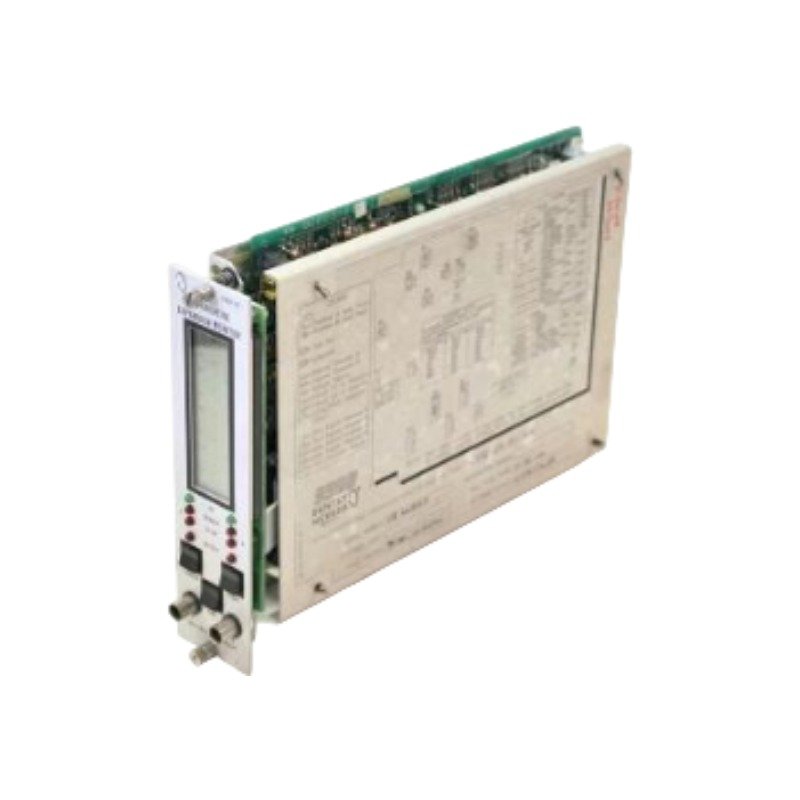
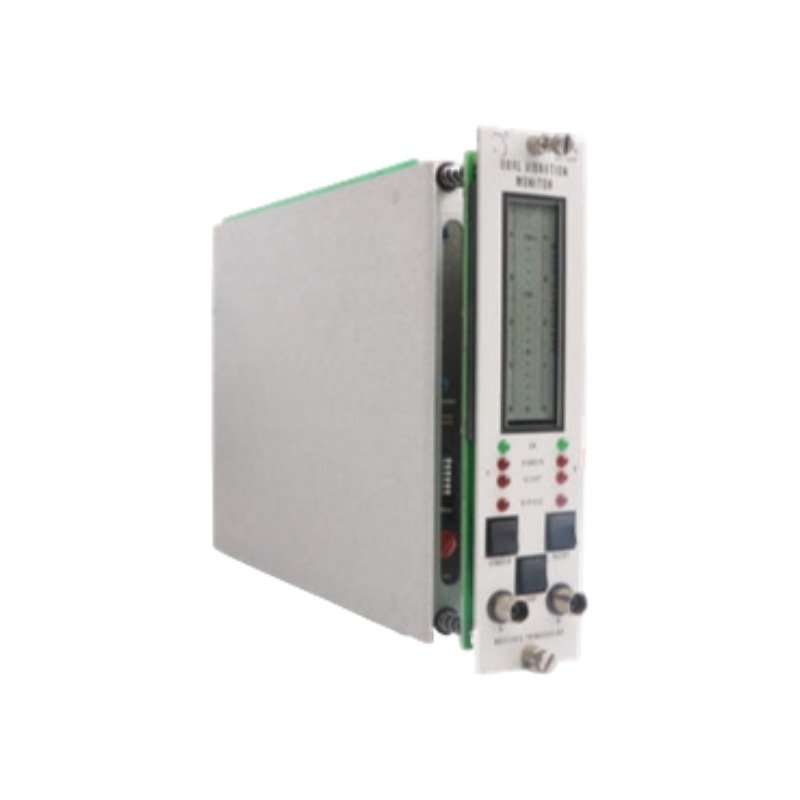
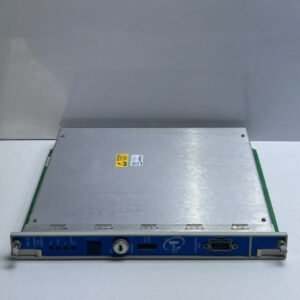
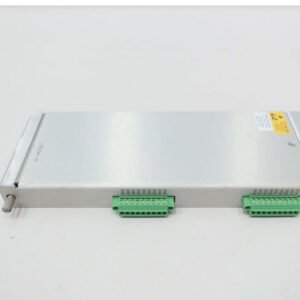
Configured for continuous radial vibration monitoring in machinery protection systems, the Bently Nevada 3300/16 (3300/16 XY Vibration Monitor) provides direct physical/electrical execution. Specifically, the system processes signals from two orthogonal proximity probe transducers mounted at 90-degree offsets on a single bearing housing, thereby resolving real-time rotor shaft dynamic orbits, peak-to-peak displacement values, and proportional 4-20 mA current outputs.
Hardware Specifications
Parameter
Specification
Model
3300/16
Brand
Bently Nevada
Origin
USA
Weight
1.0 kg
Dimensions
241 mm x 48.8 mm x 163 mm
Operating Temp
0 to +65 deg C
Power Consumption
7.2 W maximum
Signal Inputs
2 proximity probe channels (configured as an XY pair)
Analog Outputs
2 independent 4-20 mA recorder loops
Accuracy
Within 0.5% of full-scale voltage span
Frequency Response
4 Hz to 10 000 Hz (-3 dB limits)
Slot Requirements
Occupies any single monitor slot in a 3300 rack
Machinery Monitoring and Transducer Interface Dynamics
The processing hardware executes real-time eddy-current probe scaling to accurately translate physical displacement into precise electrical potentials. Consequently, gap voltage validation enforces an operational baseline of -10 VDC for standard proximity sensors, which ensures that the transducer maintains its linear range during high-frequency rotor dynamics observations. Furthermore, dynamic signal isolation circuitry constrains cross-talk suppression to under -60 dB across adjacent measurement paths, thereby preventing electrical resonance interference from corrupting critical vibration calculations.
Frequently Asked Questions
Q: How does the 3300/16 handle an individual sensor failure without tripping the shared machinery interlock loop?
A: The monitor independently executes channel OK diagnostics on both the X and Y inputs by tracking the DC gap voltage. If one sensor fails out of limits, the monitor immediately suppresses that specific channel’s alarm logic and drops its OK relay, preventing false dual-conditional trip execution.
Q: What specific hardware advantage does an XY paired configuration provide over two separate vibration monitors?
A: Combining two orthogonal inputs into a single internal microprocessor allows the monitor to accurately establish orbital shaft motion vectors. Consequently, this configuration calculates a precise true peak displacement value within the X and Y spatial layout rather than mapping independent scalar peaks.
Field Installation Guidelines
Field Wiring and Shield Terminal Isolation: Wire the transducer coaxial extension cables directly to the rear backplane terminal block assignment. Next, isolate the outer shield braid completely at the probe junction box, and then terminate the drain wire only at the designated rack ground bar to block induced magnetic field noise loops.
Orthogonal Sensor Orientation Alignment: Verify the physical proximity probes align at exactly 90-degree spatial angles relative to one another around the shaft diameter. In doing so, wire the true vertical or clockwise-ahead probe into the X channel input to ensure correct geometric orbit mapping.
Module Retaining Screw Engagement: Slide the monitor firmly along the guide tracks until the edge connectors lock flush with the backplane pin field. Afterwards, torque the upper and lower captive panel fasteners to establish full chassis ground bonding across the aluminum enclosure front plate.
Additional information
Weight
1.00 kg
Dimensions
60 × 55 × 60 mm
0.0
Average Rating
Rated
(0 Reviews)
Rated
0%
Rated
0%
Rated
0%
Rated
0%
Rated
0%
Be the first to review “Bently Nevada 3300/16 XY Vibration Monitor” Cancel reply







0.0 Average Rating Rated (0 Reviews)