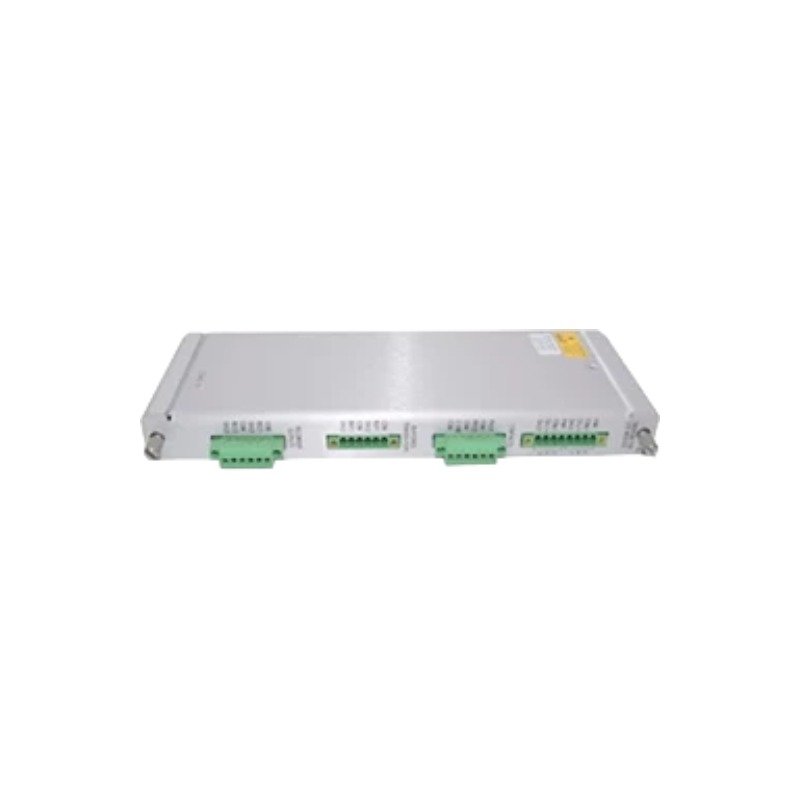
The Bently Nevada 134M3942-02, also cataloged as the 134M3942 Wireless Triaxial Vibration Sensor, operates as a dedicated hardware component for triaxial dynamic vibration and surface temperature data acquisition within ISA100.11a wireless machinery monitoring networks. It converts dynamic high-frequency acceleration vectors and casing thermal readings directly into encrypted wireless payloads for machine condition monitoring platforms.
Hardware Specifications
Parameter
Specification
Model
134M3942-02
Brand
Bently Nevada
Product Type
Wireless Triaxial Vibration Sensors
Origin
USA
Weight
760 g
Dimensions
88 mm x 45 mm x 45 mm
Operating Temp
-40 deg C to +85 deg C
Power Consumption
Replaceable 3.6 V Primary Lithium Thionyl Chloride Battery
Communication Protocol
ISA100.11a Wireless Network
Sensing Axes
Triaxial (X, Y, Z orthogonal axes)
Frequency Range
2 Hz to 10000 Hz (+/- 3 dB)
Enclosure Rating
IP67
Machinery Dynamics and Signal Conditioning Attributes
The internal architecture contains orthogonal piezoelectric accelerometer elements configured for structural vibration and multi-plane rotor dynamics evaluation. Discrete signal processing circuitry conditions raw high-frequency acceleration outputs before wireless packetizing. While continuous proximity probe loops depend on eddy-current probe scaling and gap voltage validation against -10 VDC targets for journal shaft positioning, the 134M3942-02 processing paths utilize integrated filtering algorithms to maintain digital cross-talk suppression between concurrent multi-axis spectral channels.
Frequently Asked Questions
Q: What interface conditions are needed to maintain measurement accuracy across the full 10000 Hz bandwidth?
A: High-frequency signal transfer requires direct mounting on a flat machine surface machined to a roughness better than 1.6 um Ra. The use of intermediate mounting pads or magnet bases limits high-frequency response and attenuates signals above 2000 Hz.
Q: How does the internal power management handle burst wireless transmissions?
A: Battery consumption is controlled via configurable sleep and wake-up schedules managed by the wireless gateway manager. Extending the periodic reporting interval lowers baseline current draw and prolongs internal battery cell life.
Q: What electrical test confirms effective ground isolation at the mounting point?
A: The sensor housing uses base isolation to prevent unwanted circulating ground currents. Before final tightening, verify that DC isolation resistance between the sensor chassis and the machine body measures above 10 M ohm.
Field Installation Guidelines
Mounting Surface Preparation: Spot-face the target measurement site on the bearing housing to a surface finish of 1.6 um Ra or smoother. Clean all metal shavings, paint, and oxidation from the tapped hole.
Thread Engagement Verification: Check the perpendicularity of the tapped mounting hole. Ensure a minimum of 5 full turns of thread engagement for standard mounting studs.
Torque Fastening: Apply thread-locking compound if required, then tighten the sensor onto the mounting stud using a calibrated torque wrench to 4.5 N m (40 in lb). Avoid over-torque conditions to protect internal sensing elements.
Isolation Verification: Check for electrical isolation between the sensor casing and local machine ground to eliminate ground loops.
Wireless Provisioning: Activate internal power by removing the battery isolation pin, then configure device join keys through the ISA100.11a network management console.
Additional information
Weight
0.76 kg
Dimensions
67 × 48 × 50 mm
0.0
Average Rating
Rated
(0 Reviews)
Rated
0%
Rated
0%
Rated
0%
Rated
0%
Rated
0%
Be the first to review “Bently Nevada 134M3942-02 Ranger Pro Wireless Vibration Sensor” Cancel reply






0.0 Average Rating Rated (0 Reviews)