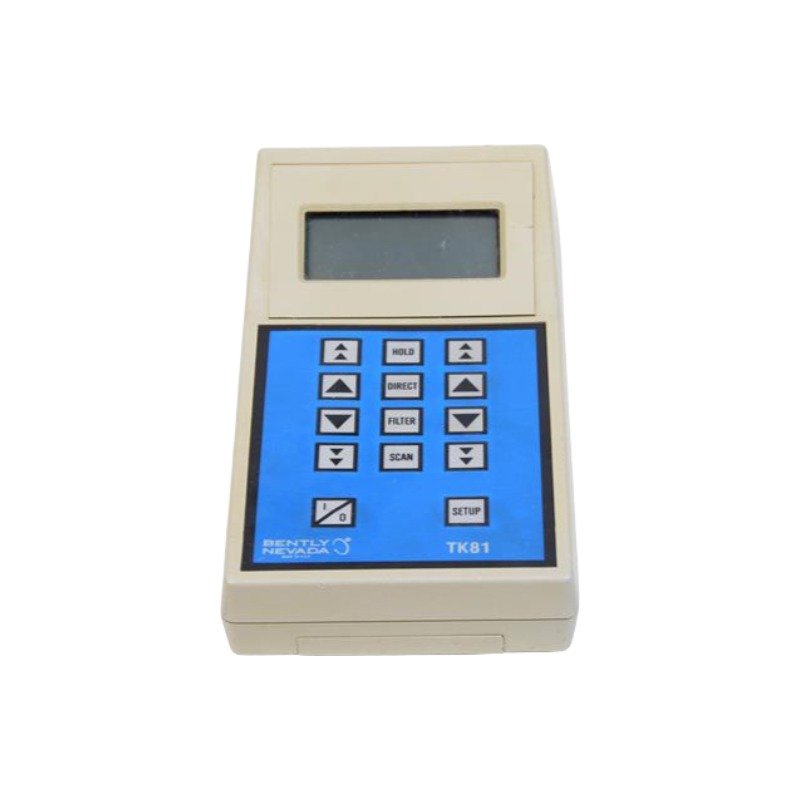
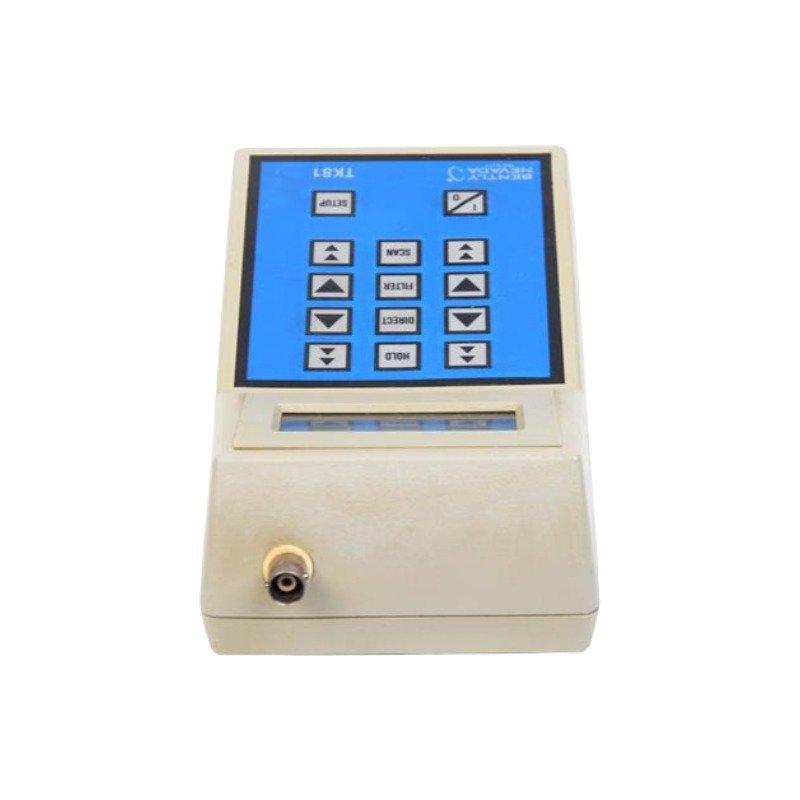
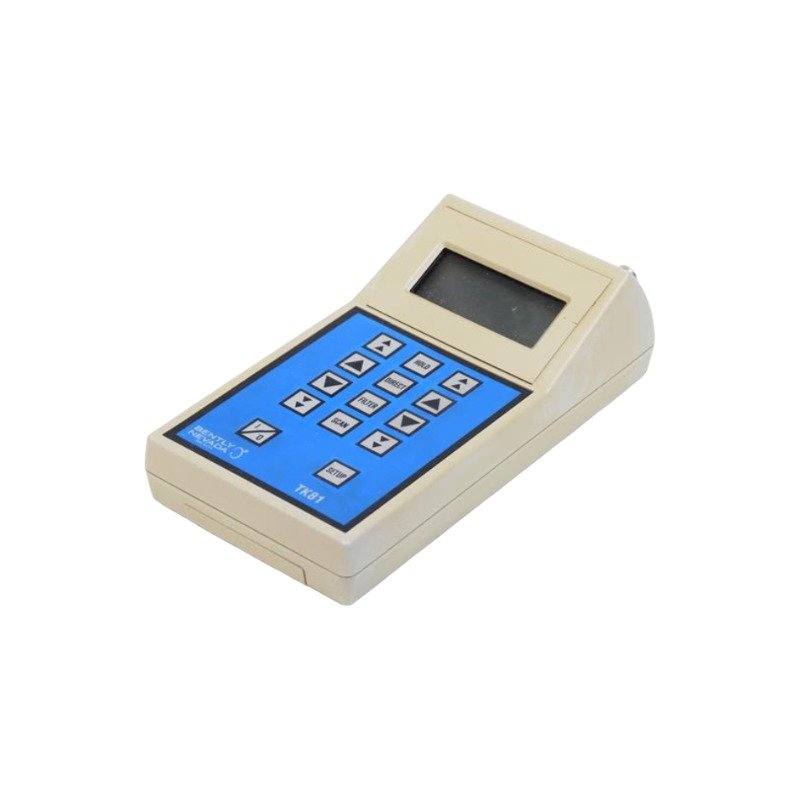
Configured for portable vibration measurement and frequency-selective filtering in rotating machinery diagnostics, the Bently Nevada TK81 (TK81 Tunable Filter and Vibration Meter) provides direct physical/electrical execution.
Hardware Specifications
Parameter
Specification
Model
TK81
Brand
Bently Nevada
Origin
USA
Weight
Handheld portable scale (exact weight not specified)
Dimensions
Handheld form factor (exact dimensions not specified)
Operating Temp
Not specified by manufacturer
Power Consumption
Handheld battery power (does not power external transducers)
Input Signals
Accepts displacement, velocity, or acceleration
Maximum Input
10 V peak-to-peak
Scale Factor
Selectable from 5 to 9999 mV per engineering unit
Input Impedance
95 kohm
Frequency Response
1.66 Hz to 1666 Hz (100 to 100,000 RPM)
Signal Integration
Single integration available for frequencies above 10 Hz (600 RPM)
Filter Operating Range
1.66 Hz to 1666 Hz (100 RPM to 100,000 RPM)
Filter Type
Digital, approximates analog filter with a Q of 11
Display
4 line by 16 character LCD
Display Units
Metric or English (peak-to-peak, zero-to-peak, or RMS)
Eddy-Current Probe Scaling and Gap Voltage Validation
The TK81 actively accepts physical signals from external displacement transducers, such as eddy-current proximity probes. Specifically, because the instrument does not supply internal transducer power, operators must power all external active proximity sensor systems separately. Additionally, when evaluating rotor dynamics, accurate displacement measurements require correct eddy-current probe scaling. Therefore, users must configure the scale factor between 5 and 9999 mV per engineering unit to match the transducer calibration. Furthermore, operators must validate the gap voltage independently on the proximity probe driver. This action ensures that the physical position of the target rotor remains within the linear range of the sensor (typically targeting a -10 VDC center-gap voltage for standard 3300 series proximity systems) before the operator routes the signal into the TK81 input channel.
Frequently Asked Questions
Q: Does the TK81 supply excitation voltage or power to connected acceleration or velocity transducers?
A: No. The TK81 operates strictly as a passive receiver of electrical signals. Consequently, the meter does not supply power or excitation voltage to any connected displacement, velocity, or acceleration transducers. Therefore, operators must use self-powered sensors or connect an external power source.
Q: Why do RMS amplitude readings fluctuate when measuring signals below 10 Hz (600 RPM)?
A: Internal digital signal processing circuits utilize specific integration time constants. Consequently, these time constants cause RMS amplitude fluctuations at low frequencies. Therefore, operators should expect this behavior during low-frequency rotor dynamics evaluation.
Q: What input impedance does the TK81 feature, and how does it execute signal integration?
A: The instrument features an input impedance of 95 kohm. Additionally, the internal circuitry performs single integration (converting acceleration to velocity, or velocity to displacement) exclusively for signal frequencies above 10 Hz (600 RPM).
Field Installation Guidelines
First, install shielded twisted-pair cabling for all transducer connections to the TK81. Subsequently, ground the cable shields at a single point (typically the transducer drive end) to suppress cross-talk and high-frequency electromagnetic interference.
Second, verify that the input signal peak-to-peak amplitude remains below 10 V. Otherwise, overloading the input channel will cause signal clipping and measurement errors.
Third, handle this portable device with care in industrial environments. Specifically, avoid exposing the unit to moisture and dust levels that exceed standard industrial limits, and keep all connection ports clean.
Finally, manually enter the correct scale factor (5 to 9999 mV per engineering unit) into the user interface. Consequently, this action aligns the instrument calculations with the calibration certificate of the connected sensor.
Additional information
Weight
0.316 kg
Dimensions
68 × 70 × 80 mm
0.0
Average Rating
Rated
(0 Reviews)
Rated
0%
Rated
0%
Rated
0%
Rated
0%
Rated
0%
Be the first to review “Bently Nevada TK81 Tunable Filter and Vibration Meter” Cancel reply






0.0 Average Rating Rated (0 Reviews)