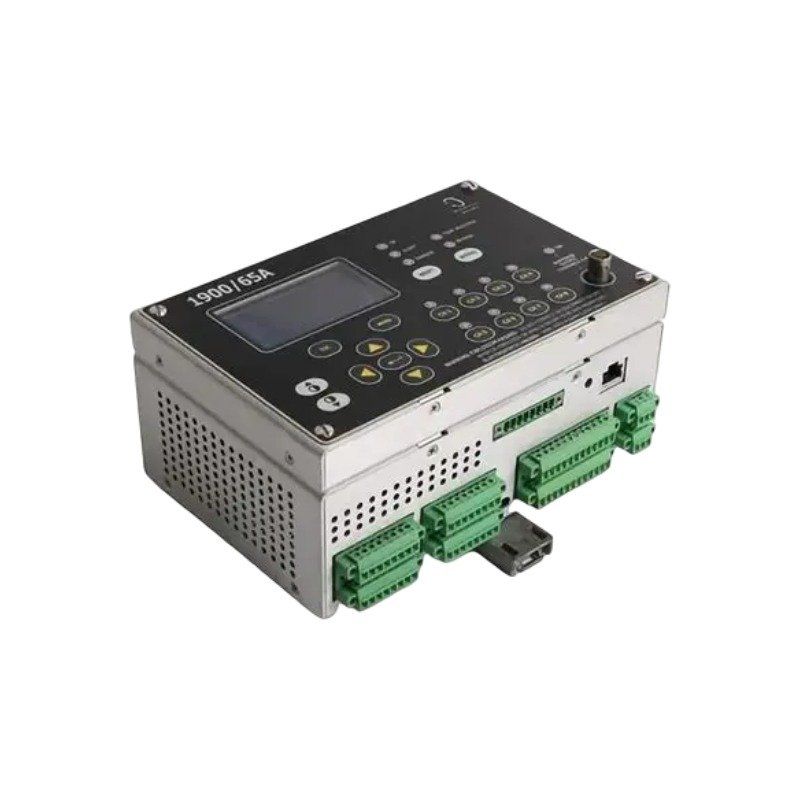
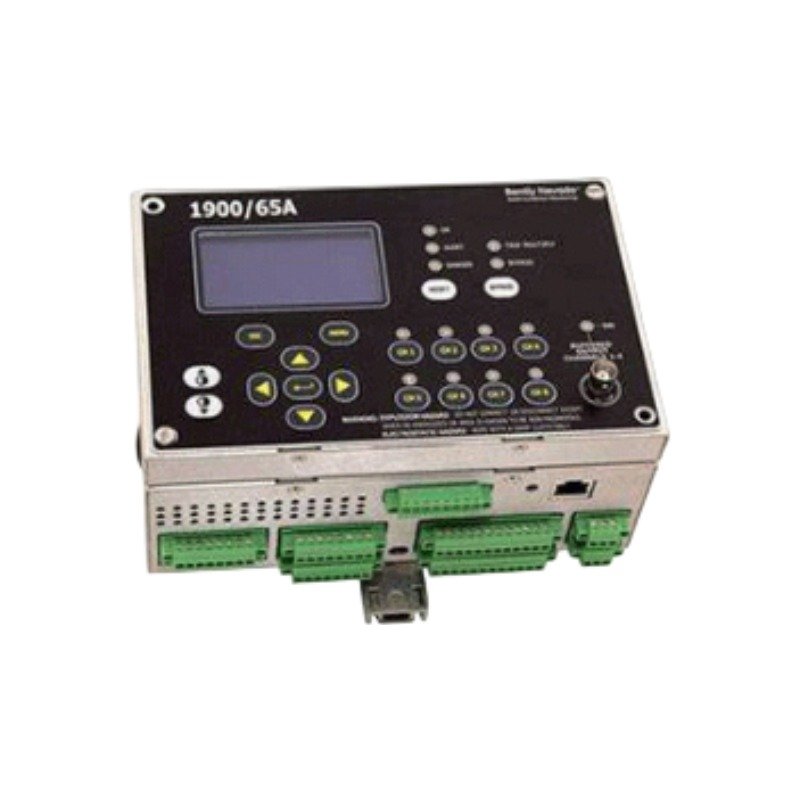
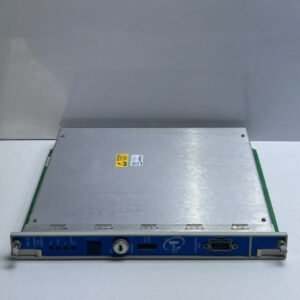
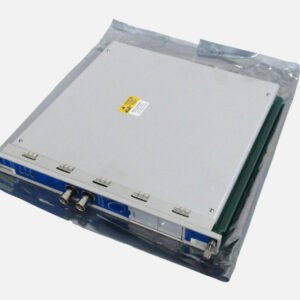
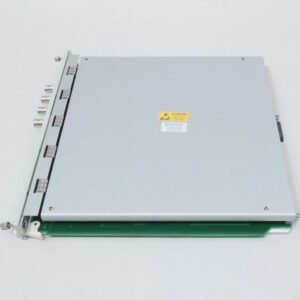
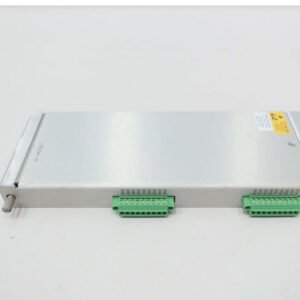
Configured for continuous vibration monitoring and thermal signal processing in machinery protection systems, the Bently Nevada 1900/65A (167699-02+172323-01) (1900/65A General Purpose Equipment Monitor) provides direct physical/electrical execution. Specifically, the system processes signals from four independent transducer inputs alongside four discrete temperature channels, thereby converting physical machinery mechanics into digitized state variables and Modbus network registers.
Hardware Specifications
Parameter
Specification
Model
1900/65A (167699-02 + 172323-01)
Brand
Bently Nevada
Origin
USA
Weight
1.4 kg
Dimensions
195 mm x 130 mm x 95 mm
Operating Temp
-20 to +70 deg C
Power Consumption
7.5 W maximum
Transducer Inputs
4 channels (2-wire or 3-wire accelerometers, velocity sensors, proximity probes)
Temperature Inputs
4 channels (Type E, J, K, T thermocouples, or 2/3-wire RTDs)
Relay Outputs
6 channels (SPDT, 5 A at 250 VAC / 30 VDC resistive)
Analog Outputs
4 channels (4-20 mA recorder outputs)
Communications
Ethernet RJ45 (Modbus TCP) and RS232/RS485 (Modbus RTU)
Machinery Monitoring and Transducer Interface Dynamics
The processing hardware executes real-time eddy-current probe scaling to accurately translate physical displacement into precise electrical potentials. Consequently, gap voltage validation enforces an operational baseline of -10 VDC for standard proximity sensors, which ensures that the transducer maintains its linear range during high-frequency rotor dynamics observations. Furthermore, dynamic signal isolation circuitry constrains cross-talk suppression to under -60 dB across adjacent measurement paths, thereby preventing electrical resonance interference from corrupting critical vibration calculations.
Frequently Asked Questions
Q: How does the module handle configuration memory retention during a complete loss of primary power?
A: The monitor permanently writes and archives all user configuration maps to on-board non-volatile EEPROM memory. As a result, the system requires no backup battery or external voltage source to retain structural operational profiles during extended power outages.
Q: What installation requirements and constraints alter the deployment of the 167699-02 display unit interface?
A: Engineers can deploy the 167699-02 remote display operator interface at distances up to 75 meters from the primary monitor base unit. However, this configuration requires a dedicated multi-conductor shielded interconnection cable to preserve signal integrity.
Field Installation Guidelines
Terminal Block Wiring and Grounding: Maintain dedicated shield integrity across all transducer cables. To avoid ground faults, float the shield at the sensor housing and terminate the drain wire exclusively at the designated monitor chassis ground terminal, thereby mitigating industrial ground loop interference.
Separation of Signal and Power Conduits: Route high-voltage AC power lines and relay contact control circuits through separate physical conduits. In doing so, isolate these lines completely from the low-voltage 4-20 mA analog outputs and sensor input wiring.
Mechanical Mounting Orientation: Securely fasten the chassis to a standard TS35 DIN-rail or panel cutout surface using heavy-duty retention clips. Additionally, maintain a minimum vertical clearance parameter of 50 mm above and below the enclosure layout to permit unhindered ambient thermal convection.
Additional information
Weight
1.40 kg
Dimensions
60 × 80 × 90 mm
0.0
Average Rating
Rated
(0 Reviews)
Rated
0%
Rated
0%
Rated
0%
Rated
0%
Rated
0%
Be the first to review “Bently Nevada 1900/65A General Purpose Equipment Monitor” Cancel reply









0.0 Average Rating Rated (0 Reviews)